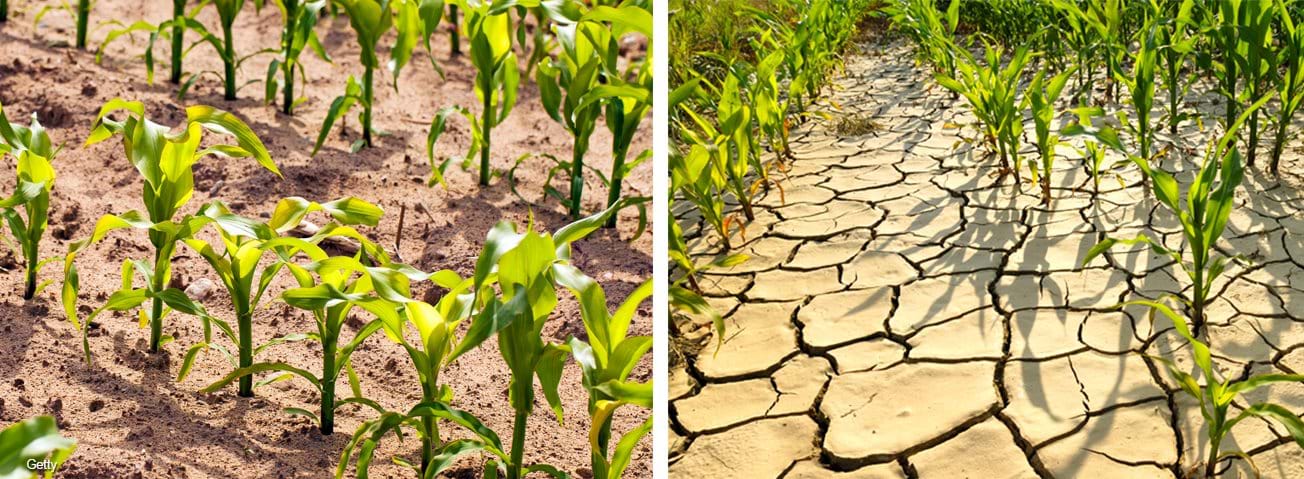
Agriculture’s Contribution to Climate Change
Agriculture reflects 10% of US greenhouse gases (GHGs), less than the 13% attributed to the commercial and residential building sector and 23% for all other industries in 2019.[1] It only comprised 5% of total GDP in 2020.[2] However, any single effort within either of those two larger sectors is much more customized to smaller niches within heavy industry and buildings than agriculture. Agriculture has fewer inputs, less complex supply chains, a wider impact internationally, a consumer market that includes everyone on the planet, an existing data ecosystem that is more readily available publicly online, a daily frequency of consumption, a strong potential for growing demand as countries develop, and a faster turn-around supply chain that more easily can be tracked from harvest to consumption. The sector’s contribution to greenhouse gases and its own inordinate use of resources (especially water, arable land) relative to GDP offers a great target for improved sustainability via a social entrepreneurial approach. That industry is also our most immediate consistent need and unites all of humanity.

The current agricultural production system is most held in place by existing government programs that fund and structure various subsidies for conventional farming practices. These subsidies ensure the current levels of over-production, keep consumer food staple prices low, support farmers’ livelihoods, and sustain the yield per acre that has set environmentally unsustainable high standards for productivity. This industrial support has many stakeholders that are entrenched into the current system and major changes in the negotiating power, the distribution of economic benefit, and industry’s farm size structure would be required. Any successful attempt to revamp agriculture requires farmers to be onboard. It would need to provide some economic carrot or stick for farming’s heavy and advance industry to concede to the change in their business prospects. This change would need to be politically popular within the greater rural community that has been politically indoctrinated into sustaining conventional farming as is and keep government out of industry. This is not easy, especially in the Republican Party dominated political landscape that holds political power in the states that produce most of the US’s three major cash crops.
Specialty crops individually take up much less land area than any of the individual three most produced cash crops in the US: corn, wheat, and soybean. Those three products are inputs into many supply chains of livestock feed and consumer product goods. The structure of the agricultural industry for these three crops is comprised of powerful entities including a) larger corporate farms, internationally prominent manufacturers of farming equipment, b) politically powerful suppliers of soil amendments like fertilizer, c) technologically advanced suppliers of agrochemical pest/weed/seed products, d) a consumer and intermediary consumer foods market that is accustomed to using a small percentage of their household budgets on agricultural products and e) health regulations and major contracts for some products dictate that sufficient levels of agrochemicals are used to ensure that disease does not spread. All of these are political, economic, and industrial impediments to changing the status quo of the current dominant mono-agricultural production method.
The benefits of any shift toward more ecologically sustainable farming are defined by adopting more agroecological practices. The inherently unstandardized nature of agroecological practices makes it difficult to promote at scale a customized method of farming that requires direct experience with a specific farming region over time. At certain points in the transition agroecology requires more labor and more inputs which requires a change in farming protocol. This is in part why agroecological practices have only been scientifically vetted to be more productive than conventional methods per acre on smaller scale farms. A very small percentage of corn, soybean, and wheat are farmed agroecologically or organically. Regenerative and organic farming practices are more widely adopted by specialty crop farming and more prominent in certain regions of the US. The limited growth of USDA certified organic farming has been an issue since the label was established.
Farmers who have already adopted organic or regenerative practices have had an ideological predisposition to it or lived in proximity to successful efforts to disseminate those practices. The distribution channels that support more sustainable farming practices are niche in nature: specialty organic food companies, specialty grocers, smaller organic sections at national chains, community supported agricultural box delivery/pickup services, farmers markets and organic livestock producers.
Free Market Capitalism Will Come Up Short
Farming is a critical part of the US economy that has concentrated itself into an ever-smaller set of increasingly larger participating firms. The unrealistic misguided yet ideal intervention would be none at all, free market capitalism dictates the market to correct itself. Firms would start to acknowledge that the deteriorating conditions of their soil are requiring ever more soil amendments. Additionally, the overall increase in the expense of their operations requires a shift in operations that requires less fertilizer, pesticides, herbicide and different method of farming that regenerates their farmland’s capacity to remain productive over the long term. The conditions in the soil required for sustained agricultural production change over decades not a growing season. The harvest of an individual season will not signal that a change is necessary. However, the Dust Bowl is a precedence of what happens when large masses of land become inarable. We can’t wait nor should we expect capitalism to fix what’s causing these marginally hard to detect changes in the productivity of US working lands.
The ecologically reasonable or environmentally-justified intervention would include the following a) US consumers to agree to start paying more for food that is grown and processed more sustainably; b) large US farmers of cash crop grains begin to experiment with different forms of agroecological practices with the help of universities technical assistance; c) government funding is made available to produce more sustainably; d) a realignment of values of the corporations results from the threats of climate change that make it evident that they invest in the resiliency of their land instead of focusing only on the cost per acre and yield metrics; e) market intermediaries change their contracts to allow for more sustainable farming practices which remain safe from disease; and f) local communities surrounding big agriculture would pressure farms, politicians and other market players to make the preceding changes if there is any resistance.
A Managed Capitalist Intervention
What would most motivate these farmers are market-based conditions that prove that organic production is a profitable systemic alternative to conventional farming. The Federal Government has the biggest incentive to make more working lands resilient to climate change by adopting more sustainable farming practices. “The Federal Government implements a number of programs that help mitigate risk in agriculture, with expenditures on these programs of approximately $120 billion over the past decade. The largest program is the Federal Crop Insurance Program (FCIP), which insures participating farmers against adverse production or market conditions. Under the FCIP, the Federal Government pays a portion of farmers’ premiums; these premium subsidies represent FCIP’s costs to the Government. [… Scenarios] with moderate emissions reductions and farmer adaptation—in which farmers adapt to changes in climate with adjustments to what they plant, where they plant it, and how they manage it—the cost of today’s FCIP would be on average about 3.5 percent higher than under a future with a climate similar to that of the recent past. Under the scenario in which emissions trends continue and farmers adapt, the cost of the FCIP would increase by an average of 22 percent.”[3]
Agroecological farming is an ideal approach that has not been sufficiently uniformly vetted at larger scale. It requires a lot of specific conditions, knowledge, and repeated attempts to successful practice it. USDA organic certified crops are a stepping-stone toward agroecological practices that has already been standardized into a three-year transition process. The expense, documentation, and change in practices required of that transition are significant hurdles that could be overcome with expanded funding of this existing certification program. Automated digital recording of agroecological farming via remote sensors could ease the documentation required of certification. Elementary economics would argue that as a greater percentage of a crop’s farmland becomes organic the price of that organic product should fall. Lower prices would make organic food more affordable to a larger market. This should entice more farms to go organic and subsequently lower prices and so on until a new economic equilibrium is reached between market supply and demand for organic produce.
On the consumer side, organic food simply should not cost more than conventional agricultural products. Conventional farming benefits from heavy federal government subsidies. Organic production of the major three cash crops has already been proven by the USDA to be more profitable than conventional production. That profit margin is shielded by several barriers to entry that the USDA should help to eliminate entirely. Developing the organic market goes hand in hand with developing the organic farming industry. There are pockets of consumers that understand the benefits and importance of buying organic. Efforts to promote organic consumption across wider swaths of US consumers should emphasize the systemic need for organic production and consumption. If more funding, technical support, and education of organic farming were introduced at a national scale the impact would go beyond the economics I’ve explained. Ecologically organic farming is a less intense form of regenerative agriculture. Over the long-term organic farming still repairs the damage of conventional farming. Organic farming isn’t as beneficial as more niche agroecological practices that are certified as regenerative. Regenerative agriculture could become the new higher price point that replaces the price premium that organic produce currently enjoys. Organic and regenerative agriculture both improve soil’s resiliency against the threats of climate change. Resiliency is in part determined by soil’s organic content composition, soil with higher organic content holds larger quantities of water per acre of land, helps to protects against extreme weather events, high or low temperatures, and is positively correlated with better growing conditions.
Critical Elements
All of this leads us to an intervention that might best address this complex transformation and situation. The way the transition is carried out requires strategic on boarding of key stakeholders during earlier stages of the transition before others will be convinced of the approach. The benefits of organic or regenerative farming also require a long enough tenure on the land for the benefits of sustainable farming to take place. Thus, generally the adoption of sustainable farming has occurred on land that is either a) owned and paid for by the farmer or b) leased for at least three years for any continuous period by the same farmer and c) small or mid-sized. These are critical market conditions that need to be reassessed by farmers and landowners who have a shared interest in propagating the health of farmland soil.
Small and large farmers will need different kinds of government support to successfully transition. Short-term large-scale contracts expected by packers and other market intermediaries makes it very difficult for large mono-agricultural farms to switch to more sustainable methods. Farms that have already bought into expensive farming processes that require large swaths of land using a highly mechanized uniform approach that depends on large economies of scale from the incremental use of simplified farming inputs have little financial incentive to overhaul their farming methods.
See it for yourself
If you need to see it to believe that the lowest hanging fruit to defend ourselves against climate change isn’t electric cars, renewable energy, green building, or revamping our factories to be green, NASA delivers that from space! NASA’s Orbiting Carbon Observatory, 2 (OCO-2) provides the most complete dataset tracking the concentration of atmospheric carbon dioxide (CO2), the main driver of climate change. Every day, OCO-2 measures sunlight reflected from Earth’s surface to infer the dry-air column-averaged CO2 mixing ratio and provides around 100,000 cloud-free observations.
What really sets agriculture apart is its potential to remove carbon dioxide (CO2) from the atmosphere and sequester it in soil. The key to “sequestering” or successfully capturing and storing some of the assimilated carbon into the soil depends upon the farmer’s use of carbon-smart best management practices including minimal or no-till systems and the use of cover crops. Tilling happens as a process of preparing the soil to plant crops into it.
The following NASA visualization shows the atmosphere in three dimensions and highlights the accumulation of CO2 during a single calendar year. Every year, the world’s vegetation and oceans absorb about half of human CO2 emissions, providing an incredibly valuable service that has mitigated the rate of accumulation of greenhouse gases in the atmosphere. This happens while crops are growing in the latter half of the year after crops are planted.
The volumetric visualization starts in June 2020, showing all of the model’s values of global CO2. The cloudiness the blocks the view of the earth is an indication, among other things, of the carbon released from the soil when it is tilled as a part of the process of planting crops. The earth becomes more visible as crops and other systemic climate change forces, like oceans, do their part to remove carbon the atmosphere, every year.
[1] US EPA, OAR. 2015. “Sources of Greenhouse Gas Emissions.” Overviews and Factsheets. December 29, 2015. https://www.epa.gov/ghgemissions/sources-greenhouse-gas-emissions.
[2] “USDA ERS – Ag and Food Sectors and the Economy.” n.d. Accessed March 31, 2022. https://www.ers.usda.gov/data-products/ag-and-food-statistics-charting-the-essentials/ag-and-food-sectors-and-the-economy/.
[3] “USDA ERS – Climate Change Projected To Increase Cost of the Federal Crop Insurance Program Due to Greater Insured Value and Yield Variability.” n.d. Accessed September 10, 2022. https://www.ers.usda.gov/amber-waves/2019/november/climate-change-projected-to-increase-cost-of-the-federal-crop-insurance-program-due-to-greater-insured-value-and-yield-variability/.
Agriculture Image Sourced from Amer Waves, ERS USDA, 2019, https://www.ers.usda.gov/amber-waves/2019/august/climate-change-likely-to-have-uneven-impacts-on-agricultural-productivity/
 The Multifaceted Market Researcher